Teams change their minds all the time. A deadline moves, a vendor changes, someone asks you to forget what they shared. An assistant that remembers only what was said first is worse than no assistant, because it answers with confidence and it is wrong.
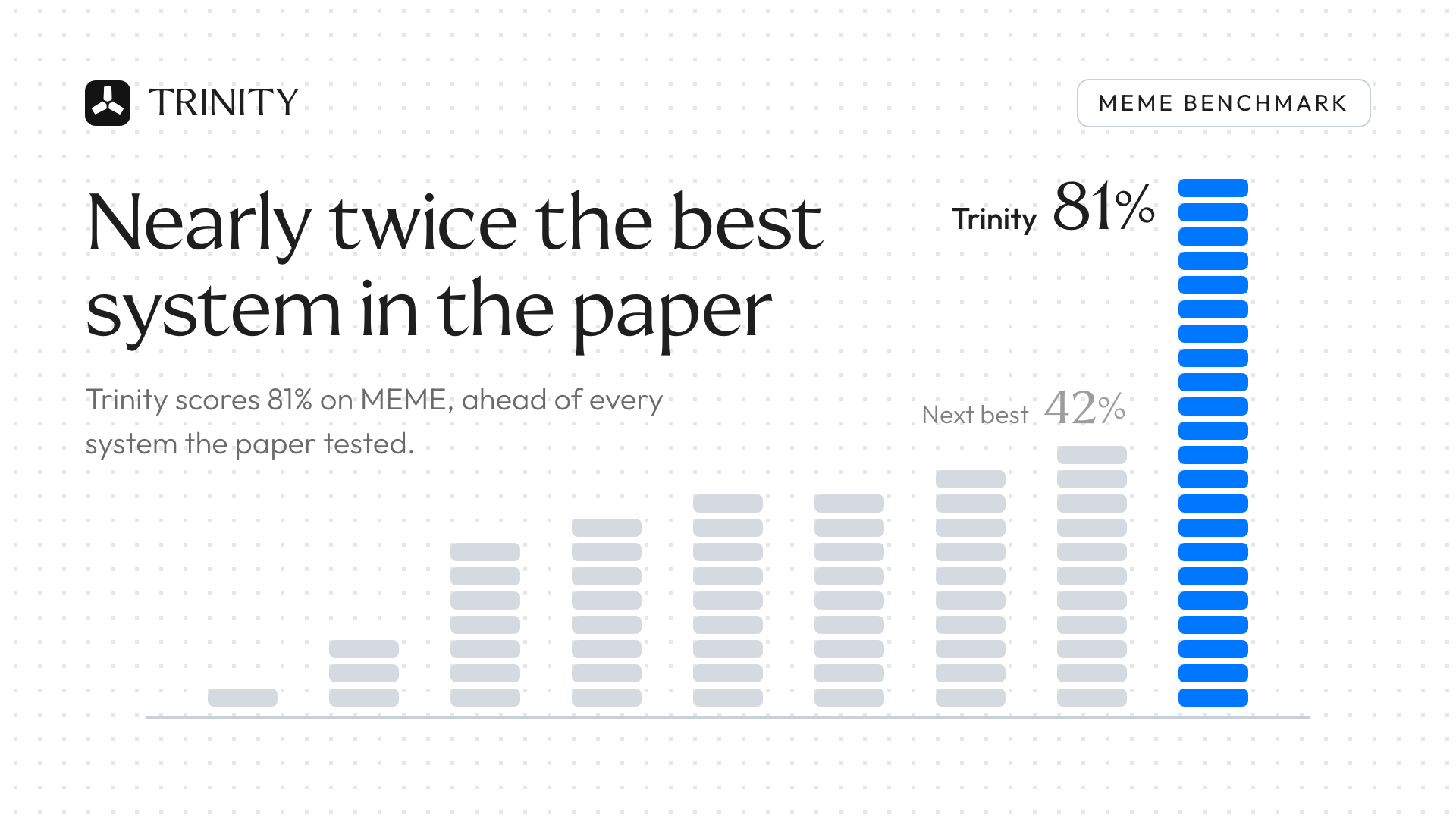
MEME is a public benchmark built to test exactly this. We ran Trinity on all 100 of its episodes and scored every answer with MEME's own unmodified judge. Trinity scored 81%. The best system in the paper's main results scored 42%.
Trinity leads on five of the six tasks, and its widest margins are where memory usually breaks: following a change through to the facts that depend on it, and knowing when an old answer no longer holds. Here is Trinity against the best score on each task in the paper's main results:
| Task | Trinity | Best in the paper's main table | Trinity's lead |
|---|---|---|---|
| Cascade | 70% | 6% | +64 points |
| Absence | 75% | 35% | +40 points |
| Aggregation | 80% | 45% | +35 points |
| Deletion | 78% | 45% | +33 points |
| Tracking | 88% | 77% | +11 points |
| Overall | 81% | 42% | +39 points |
It is also cheap. The whole run, 1,088 questions across 100 episodes, took under eight hours on a production-equivalent setup and cost us $3.
What MEME tests
MEME (Multi-entity and Evolving Memory Evaluation) replays long conversations in which facts are stated, updated, combined and withdrawn, mixed in with about 32,000 tokens of unrelated conversation per episode. At checkpoints along the way, it asks six kinds of question:
| Task | The question behind it |
|---|---|
| Exact recall (ER) | What was said? |
| Aggregation (Agg) | What do several facts add up to? |
| Tracking (Tr) | What is the value now, after it changed? |
| Deletion (Del) | Someone asked to forget a fact. Is it kept out of answers? |
| Cascade (Cas) | A fact changed, and another fact depended on it. Is the change followed through? |
| Absence (Abs) | A change means an old answer may no longer hold. Does the assistant say it is uncertain instead of repeating it? |

Deletion, Cascade and Absence are where memory systems fail, and MEME scores them strictly. A pass counts only if the assistant also knew the original fact before it changed, so a right answer reached without ever knowing the fact earns nothing.
How we ran it
We did not build a special pipeline around a model. We ran the product, the way a team uses it.
Each episode got a new Trinity project. Every conversation in it, the unrelated ones included, arrived as a meeting note through the same signed webhook a real meeting tool sends, and Trinity captured and indexed each note as it does in production. Every question went to Trinity's Ask, the same one people use in Slack and on the dashboard, in a new conversation each time, so no answer could lean on the one before.

- Dataset: MEME's 32K-filler variant, all 100 episodes (50 about personal life, 50 about a software project), at a pinned, checksummed revision
- Judge: MEME's own judge code, unmodified, on GPT-4o, the judge model the paper uses (pinned to the
gpt-4o-2024-08-06snapshot) - Answering: Trinity's Ask, on gpt-6-luna at extra-high reasoning effort
- Questions: 1,088 asked. The 694 asked at the end of each episode are scored, and the 394 asked earlier decide whether a Deletion, Cascade or Absence pass counts. MEME's judge never scores the other 100 questions in the set, so we skipped them. Every question got an answer.
- Setup: a production-equivalent Trinity stack, six episodes at a time, 7 hours 49 minutes end to end
Results
| Task | Passes | Score |
|---|---|---|
| Exact recall | 96 / 100 | 96.0% |
| Aggregation | 80 / 100 | 80.0% |
| Tracking | 88 / 100 | 88.0% |
| Deletion | 78 / 100 | 78.0% |
| Cascade | 114 / 164 | 69.5% |
| Absence | 98 / 130 | 75.4% |
| Overall (mean of the six tasks) | 81.1% | |
| All scored questions together | 554 / 694 | 79.8% |

The score holds across both kinds of conversation: 81.7% on the personal-life episodes and 80.5% on the software-project ones.
How Trinity compares
The MEME paper tested six memory systems and two models reading the whole transcript, on the same 100 episodes, with the same judge and the same strict scoring.
| System | ER | Agg | Tr | Del | Cas | Abs | Overall |
|---|---|---|---|---|---|---|---|
| Trinity | 96% | 80% | 88% | 78% | 70% | 75% | 81% |
| MD-flat | 94% | 45% | 77% | 25% | 6% | 5% | 42% |
| Whole transcript, GPT-4.1 mini | 100% | 27% | 69% | 45% | 3% | 4% | 36% |
| text-embedding-3-small | 96% | 33% | 46% | 17% | 4% | 0% | 33% |
| Whole transcript, Claude Sonnet 4.6 | 50% | 21% | 58% | 39% | 5% | 35% | 32% |
| Mem0 | 67% | 35% | 43% | 21% | 3% | 0% | 28% |
| BM25 | 100% | 5% | 16% | 27% | 2% | 0% | 25% |
| Karpathy Wiki | 11% | 18% | 27% | 3% | 1% | 2% | 10% |
| Graphiti | 3% | 1% | 4% | 9% | 2% | 1% | 3% |
Every row but Trinity's is Table 2 of the paper. Trinity's overall is the mean of its six task scores, the way the paper computes it for memory systems.

In the paper's main results, Trinity leads every column but one. On Cascade, no other system scores above 6%; Trinity scores 70%. On Absence, no memory system scores above 5%, and the strongest baseline, Claude Sonnet 4.6 reading the whole transcript, reaches 35%; Trinity scores 75%. The one column it does not lead is exact recall, where BM25 and the GPT-4.1 mini whole-transcript baseline score 100% and Trinity scores 96%.
The paper also reports two results outside its main table. Trinity clears the first and comes close to the second:
- The best result it found with any memory system: 55%. MD-flat reached it with Claude Opus 4.7 writing its memory, on a 20-episode subset, at about 70 times the cost of its baseline. Trinity's 81% is 26 points higher, and Trinity is also ahead on Cascade (70% against 32%) and Absence (75% against 59%).
- Its ceiling: 91%. That is Claude Opus 4.7 handed only the relevant facts, with no unrelated conversation and nothing to search: the paper's estimate of what is solvable when memory is perfect. Trinity is 10 points short of it, and on Absence its 75% is above the 72% Opus 4.7 scores in that setup (Claude Sonnet 4 scores 81% there).

The models are not the same, and we want to be plain about it. The paper's main table runs every system on GPT-4.1 mini, a small, cheap model, while Trinity answers with a frontier reasoning model. But the paper also shows that a stronger answering model alone does not fix change: with Claude Sonnet 4 writing the answers, no system scored above 5% on Cascade or 16% on Absence. What moves these two tasks, we believe, is less the model than how Trinity reads.
Why Trinity keeps up with change
Most of the systems in the paper are built to remember. They turn what was said into something they can search (notes, extracted memories, embeddings, a keyword index or a graph) and answer from that.
A store like that can answer "what was said?" well: BM25, a plain keyword index, gets every exact-recall question right. It is not enough once facts start to move. A search returns whatever matches the question best, and the old fact can match as well as the new one. The note that records a change names what changed, not the facts that depend on it, so a search for a dependent fact can miss the change entirely. The same BM25 scores 2% on Cascade and 0% on Absence.

Trinity is built to check what is still true, not only to recall what was said. It keeps the sources themselves, and for every question it goes back to them and reads them the way a careful colleague would:
- Newest first, and in full. The note that best matches a question is not always the one that is still true. A deadline can move in passing, in a later meeting about something else, so Trinity reads the newest sources first, and reads them whole.
- Every change, followed through. When a fact changes, Trinity looks for what was built on it: the budget that assumed the old vendor, the launch that assumed the old date. Following changes through is also how it notices when an old answer no longer holds, and says so instead of repeating it.
- Forgotten means forgotten. When someone asks for something to be forgotten, Trinity's rule is to keep it out of every later answer, even though the note it came from is still on file.

None of this is a mode for the benchmark. It is how Trinity's Ask answers every question, in Slack and on the dashboard.
What it costs
Going back to the sources for every answer sounds expensive. It is not, because Trinity reads only the notes a question needs. The whole benchmark, all 100 episodes and 1,088 questions, ran on a production-equivalent setup in 7 hours 49 minutes and cost us $3.
Answers are quick, too. The median answer takes 58 seconds and 17 tool calls. About 65% of those calls open a meeting note, and another 13% search notes by meaning: Trinity finds the candidates, reads them, and answers from what they say now.

Compare that with the usual way to buy a better score. The paper's best memory result, 55%, needed Claude Opus 4.7 to write the memory, at about 70 times the cost of its baseline. And a model that reads the whole transcript pays for the entire conversation so far, every time it is asked a question.
What other memory companies report
We read the benchmark pages of the memory companies people ask us about, to see what they measure and whether any had run MEME. As of November 10, 2026, one has published MEME numbers: Sentra.
| Company | MEME? | What it publishes instead (self-reported) |
|---|---|---|
| Sentra | Yes, two tasks | Cascade 40%, Absence 43%. No overall score, no other tasks, and no episode count, answer model or judge disclosed. |
| Mem0 | Tested by the paper (28%), not by Mem0 | LoCoMo 92.5%, LongMemEval 94.4%, BEAM 64.1% at 1M tokens |
| Zep | Its engine, Graphiti, tested by the paper (3%) | LongMemEval 90.2%, LoCoMo 94.7% (GPT-5.4 answering and judging) |
| Supermemory | No | LongMemEval-S 97% with GPT-4o answering; 84.6% with GPT-5 and 85.2% with Gemini 3 Pro |
| Letta | No | LoCoMo 74.0% (GPT-4o mini, files and grep) |
| Honcho | No | LongMemEval-S 90.4%, LoCoMo 89.9%, BEAM 63% at 1M tokens (Claude Haiku 4.5) |
| Cognee | No | BEAM up to 67% at 10M tokens |
| Hindsight | No | LongMemEval 91.4% (Gemini 3 Pro), BEAM 64.1% at 10M tokens |
| AutoMem | No | LongMemEval 87.0%, LoCoMo 84.7% |
The page behind every figure is listed under Sources at the end.
Sentra's two MEME numbers beside Trinity's:
| Task | Trinity | Sentra |
|---|---|---|
| Cascade | 70% | 40% |
| Absence | 75% | 43% |
Trinity leads on both. Sentra does not say how its run was set up, so this compares published claims rather than equal runs; ours is set out above in full.
Everyone else reports LongMemEval, LoCoMo or BEAM, often at 85% to 95%. Those benchmarks mostly ask what was said. LongMemEval and BEAM include facts that were updated, but none of the three asks whether a change carries through to the facts that depend on it, or about something a person asked to forget. That is where MEME separates systems: four systems in the paper recall exact facts at 94% or better, and every one of them scores 6% or less on Cascade. Each company also runs these benchmarks with its own answering model and judge, so their numbers do not compare with each other, let alone with MEME.
How the harness works
One command runs the whole benchmark. It starts a fresh Trinity stack, replays every episode, asks every question and scores the answers with MEME's own judge. Every answer keeps its full trace (what it read, every tool call, and the expected answer beside it), so when a question fails, we read why instead of guessing.
If you build memory systems, we would welcome your MEME numbers, run the same way: all 100 episodes, MEME's own judge, strict scoring, every task reported.
Sources
Every number in this post that is not Trinity's own comes from one of these pages, each read on November 10, 2026. The company figures are each company's own claims; we have not rerun them.
- MEME paper: Jung et al., MEME: Multi-entity & Evolving Memory Evaluation, NeurIPS 2026. Our comparison table is its Table 2. The 55% result is Table 4 and its cost Table 6, the Claude Sonnet 4 answers are Table 16, and the 91% ceiling is Table 19. What LoCoMo and LongMemEval test is its Table 1.
- BEAM: Tavakoli et al., Beyond a Million Tokens, for the ten abilities BEAM tests
- Sentra: MemoryBench Explained, updated November 9, 2026
- Mem0: Mem0 Research
- Zep: Agent memory benchmarks
- Supermemory: LongMemEval-S evaluation report
- Letta: Benchmarking AI Agent Memory: Is a Filesystem All You Need?, August 12, 2025
- Honcho: Benchmarking Honcho, Plastic Labs, December 19, 2025
- Cognee: cognee on BEAM, June 26, 2026
- Hindsight: LongMemEval from the paper Hindsight is 20/20, December 2025; BEAM from Hindsight Is #1 on BEAM, April 2, 2026
- AutoMem: Benchmarks